
AI Integration
Unlock the power of artificial intelligence by integrating intelligent capabilities into your existing applications, workflows, and business systems. Our AI integration services help businesses connect AI models, Generative AI, machine learning, automation, and intelligent agents with their existing technology ecosystem.
Start Your AI Development Journey Today!
- Home /
- AI Development
AI INTEGRATION SERVICES
AI integration enables businesses to enhance their existing technology without replacing their entire infrastructure. We help you identify where AI can fit into your applications and workflows and build integrations that improve automation, decision-making, personalization, and operational efficiency.
Our team handles the complete integration lifecycle—from AI model and technology selection to API development, data integration, testing, deployment, and ongoing optimization.
AI Solutions That Drive Business Growth
Our AI development services help enterprises innovate, automate, and scale. From strategy and consulting to building and integrating custom solutions, our team ensures every initiative delivers measurable business impact and long-term value, whether you’re modernizing legacy systems or creating intelligent products from scratch.
AI Model Integration
Integrate machine learning models, Generative AI models, LLMs, and predictive models into your existing applications and business systems.
Generative AI Integration
Integrate LLMs and Generative AI capabilities into applications for content generation, knowledge assistance, document processing, search, automation, and conversational experiences.
AI API Integration
Connect AI services and models with your software through secure and scalable APIs, enabling applications to access intelligent capabilities in real time.
AI Chatbot Integration
Integrate intelligent conversational assistants into websites, mobile applications, customer portals, and enterprise platforms to automate customer interactions.
AI Agent Integration
Connect AI agents with business tools, databases, APIs, and workflows so they can retrieve information, execute tasks, and automate multi-step processes.
Machine Learning Integration
Integrate predictive analytics, recommendation systems, classification models, forecasting, anomaly detection, and other ML capabilities into business applications.
Enterprise AI Integration
Connect AI capabilities with enterprise applications such as CRM, ERP, HRM, CMS, business intelligence platforms, and internal systems.
Cloud AI Integration
Integrate cloud-based AI services and machine learning platforms with your existing infrastructure for scalable AI deployment and management.
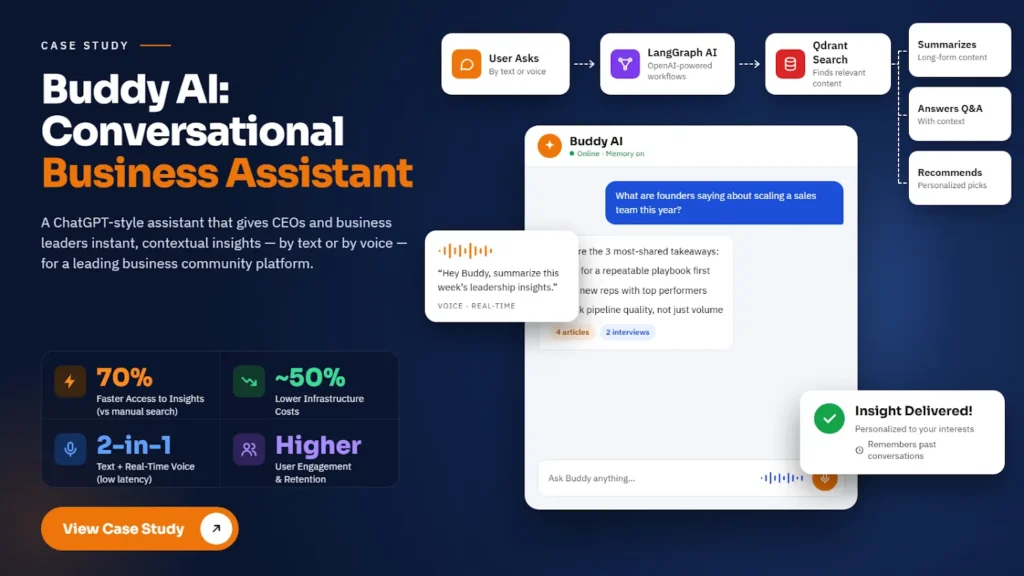
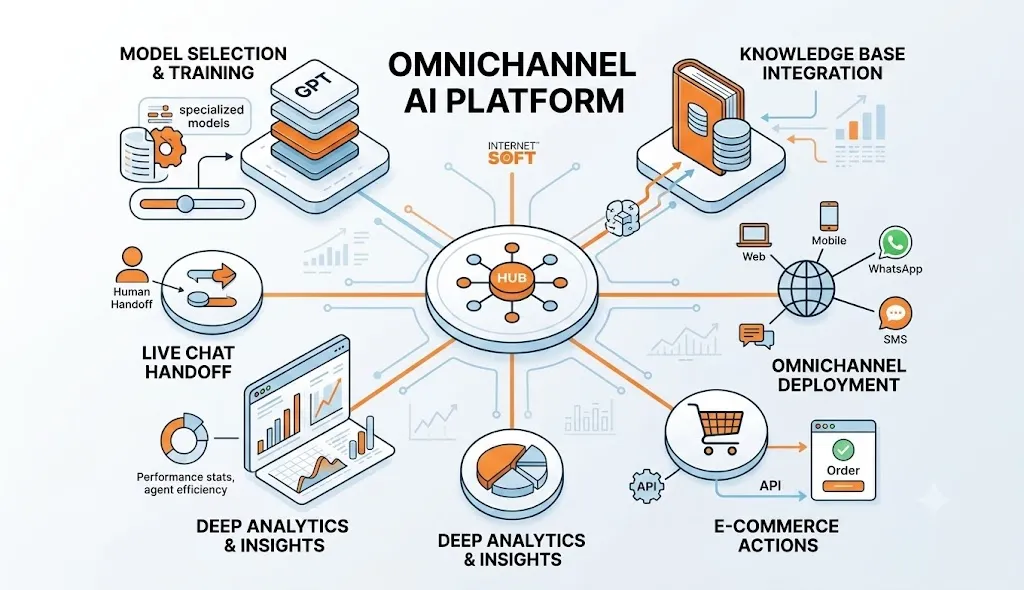
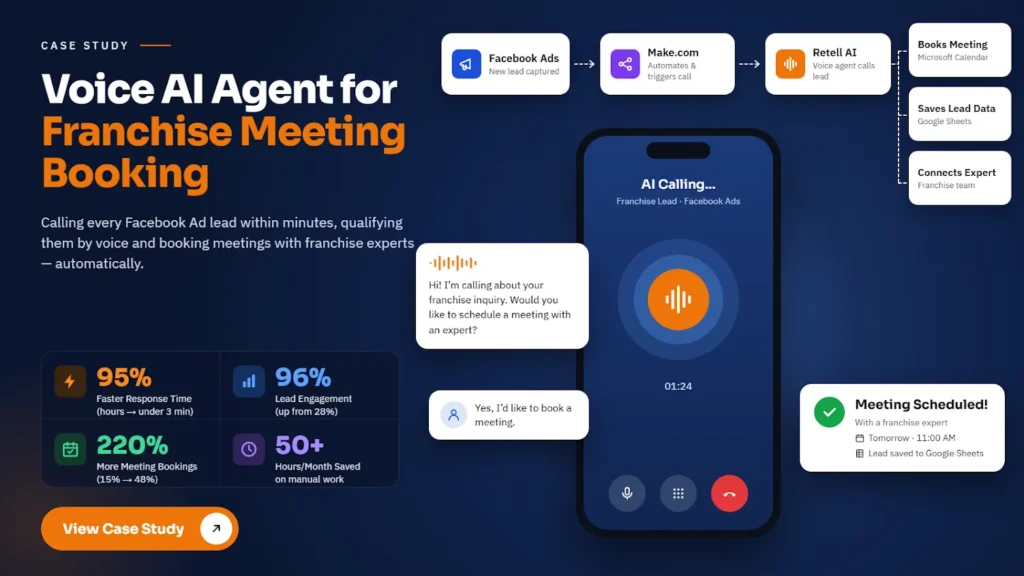
CASE STUDIES
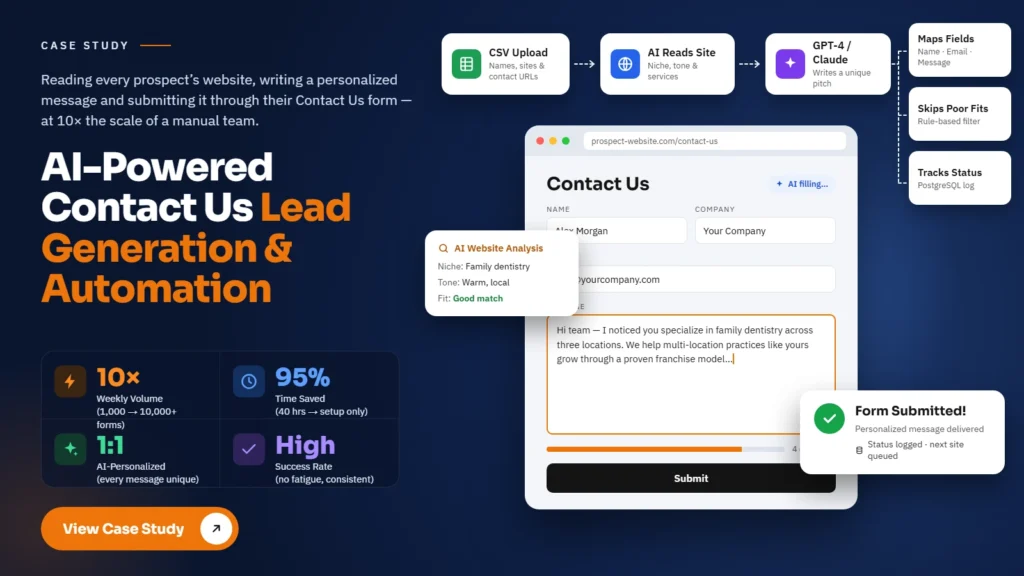
From AI-powered applications to enterprise software, our case studies demonstrate how we create scalable, high-performing solutions that drive business growth and operational efficiency.
Operational Challenges
Developing AI solutions can be complex, from handling large data sets to ensuring consistent model performance. As a custom AI development company, our experts deliver tailored, end-to-end AI solutions development that ensures reliability, scalability, and business impact.
Legacy System Compatibility
Existing systems may not be designed for modern AI technologies. We design integration layers and APIs that allow AI capabilities to work with legacy and modern applications.
Fragmented Data Sources
AI applications often require information from multiple systems. We connect databases, APIs, cloud platforms, and enterprise data sources to create reliable data flows.
Complex API Integration
Connecting multiple AI models and business systems can create technical complexity. We develop secure APIs and integration architectures that simplify communication between systems.
Data Security & Privacy
AI integrations may process sensitive business or customer information. We incorporate appropriate security, authentication, authorization, and data protection practices.
AI Model Selection
Choosing the right model for a specific use case can be challenging. We evaluate available AI models based on performance, cost, scalability, latency, and business requirements.
Scalability
AI workloads can increase rapidly as adoption grows. We design scalable architectures capable of handling increasing users, requests, data, and processing requirements.
Integration Performance
Poorly designed integrations can increase latency and affect application performance. We optimize APIs, data flows, caching, model serving, and infrastructure to support responsive AI experiences.
Managing AI Costs
AI APIs, models, infrastructure, and data processing can introduce additional costs. We help design efficient architectures and select appropriate technologies based on your requirements.
OUR AI INTEGRATION PROCESS
We follow a structured approach to integrate AI capabilities into your existing technology ecosystem with minimal disruption.
1
System & Business Assessment
We analyze your existing applications, workflows, infrastructure, data sources, business requirements, and integration challenges.
2
AI Use Case Identification
We identify where AI can add value and determine which processes, applications, or systems are suitable for AI integration.
3
Technology & Model Selection
We evaluate AI models, APIs, frameworks, cloud services, databases, and infrastructure to select technologies appropriate for your requirements.
4
Integration Architecture
We design the integration architecture, defining APIs, data flows, authentication, AI services, databases, applications, and infrastructure.
5
Development & Integration
Our engineers develop APIs, connectors, middleware, AI workflows, and application components required to connect AI capabilities with your existing ecosystem.
6
Testing & Validation
We test integrations for functionality, security, performance, reliability, scalability, and AI response quality.
7
Deployment
The integrated solution is securely deployed into your production environment with appropriate monitoring and infrastructure configuration.
8
Monitoring & Optimization
We continuously monitor system performance, AI outputs, API usage, infrastructure, and costs to identify opportunities for improvement.
WHY CHOOSE INTERNET SOFT?
Connect Your Technology Ecosystem With Intelligent AI
Internet Soft combines AI expertise with software engineering, cloud, data, API development, and enterprise integration capabilities to help businesses adopt AI without disrupting their existing technology environment.
End-to-End Integration Expertise
From AI model selection and architecture to development, deployment, and optimization, we manage the complete integration lifecycle.

15+
Years of Software Engineering Experience
100+
Certified Full-Time Professionals
265+
Technology Professionals Across Diverse Skills & Industries
700+
Projects Delivered Worldwide
700+
Projects Delivered Worldwide
Business-Focused Solutions
We integrate AI based on your business objectives, workflows, existing systems, and measurable outcomes.
Scalable Architecture
Our integration solutions are designed to support growing data volumes, users, AI workloads, and business requirements.
Secure Integrations
We consider authentication, authorization, data protection, API security, access controls, and monitoring when designing AI integrations.
Multi-Platform Integration
Connect AI capabilities across websites, mobile applications, enterprise software, cloud platforms, APIs, databases, CRM, ERP, and other business systems.
TECHNOLOGY STACK
We use modern AI, API, cloud, data, and integration technologies to connect intelligent capabilities with your existing applications and business ecosystem.
ML Frameworks
TensorFlow
PyTorch
Scikit-learn
XGBoost
Keras
AI Models
Machine Learning Models
Deep Learning Models
Predictive Models
Recommendation Models
Computer Vision Models
Large Language Models
OpenAI
Anthropic
Google Gemini
Meta Llama
Hugging Face
AI Development
LangChain
LlamaIndex
LangGraph
RAG
AI Agents
Vector Databases
Pinecone
Weaviate
Chroma
Qdrant
Milvus
API Technologies
REST APIs
GraphQL
GraphQL
Microservices
API Gateways
Integration
Third-Party APIs
Enterprise APIs
CRM Integration
ERP Integration
Payment & Business APIs
Model Serving
BentoML
Ray Serve
TF Serving
Triton
Databases
PostgreSQL
MySQL
MongoDB
Redis
Data Platforms
Snowflake
BigQuery
Databricks
Amazon Redshift
Vector Databases
Pinecone
Qdrant
Weaviate
Milvus
Chroma
Cloud Platforms
AWS
Microsoft Azure
Google Cloud
AI Platforms
AWS Bedrock
AWS SageMaker
Azure AI
Azure Machine Learning
Google Vertex AI
Infrastructure
Docker
Kubernetes
Serverless Architecture
Azure AI
Azure ML
Azure OpenAI
Cognitive Services
AI Foundry
Model Lifecycle
MLflow
Kubeflow
DVC
Weights & Biases
Deployment & Monitoring
TensorFlow Serving
NVIDIA Triton
Model Monitoring
Performance Monitoring
Automated Retraining
Frequently Asked Questions
AI integration is the process of connecting artificial intelligence capabilities with existing applications, software, databases, workflows, and business systems to introduce intelligent functionality.
AI integration can enhance existing applications with automation, prediction, personalization, intelligent search, conversational capabilities, recommendations, and data-driven insights without requiring a complete system replacement.
Key benefits of integrating AI include:
- Smarter decision-making: AI turns business data into clear, actionable insights
- Improved efficiency: Automation reduces repetitive tasks and operational delays
- Cost savings: Optimized processes lower long-term expenses
- Better customer experience: AI delivers personalized services and quicker responses
- Scalability: AI solutions grow alongside your business needs
- Competitive advantage: AI helps you adapt quickly and stay ahead in your industry
Yes. AI can be connected to legacy applications through APIs, middleware, integration layers, databases, and custom connectors depending on the architecture of the existing system.
Projects with clean, well-structured data, along with clearly defined goals, move faster. However, more complex use cases, advanced AI models, or heavy third-party integrations may require more time. Thorough testing is also essential to ensure accuracy, reliability, and performance.
A typical timeline includes:
- Problem definition and planning: 2 to 4 weeks
- Data collection and preparation: 4 to 12 weeks
- Model development and training: 8 to 16 weeks
- Testing and evaluation: 4 to 8 weeks
- Deployment and Maintenance: Ongoing
Yes. LLMs and Generative AI capabilities can be integrated into websites, mobile applications, enterprise software, knowledge platforms, customer support systems, and internal business tools.
Yes. AI can be integrated with CRM, ERP, HRM, CMS, and other enterprise platforms through APIs, connectors, middleware, and custom integrations.
Security depends on the architecture, data, AI platform, and systems involved. We incorporate appropriate authentication, authorization, encryption, access controls, API security, and monitoring into the integration architecture.
The timeline depends on the complexity of the application, number of systems involved, AI functionality, data requirements, APIs, and deployment environment. Simple integrations can be completed faster than complex enterprise integrations.
Yes. Applications can use multiple AI models or providers depending on the requirements for specific tasks, performance, cost, latency, and functionality.