
Agentic AI Development
Build intelligent, autonomous AI systems that can reason, plan, make decisions, and take action. Internet Soft develops Agentic AI solutions that work across business workflows, applications, and data sources to automate complex processes and deliver measurable business outcomes.
Start Your AI Development Journey Today!

AGENTIC AI DEVELOPMENT
At Internet Soft, we build intelligent Agentic AI systems that go beyond traditional automation and conversational AI. Our AI agents can understand goals, reason through complex tasks, interact with tools and applications, and execute multi-step workflows with minimal human intervention.
From autonomous business process automation and intelligent assistants to multi-agent systems and enterprise AI workflows, we design secure, scalable, and context-aware solutions tailored to your business needs.
AI Solutions That Drive Business Growth
Our Agentic AI development services help businesses automate complex workflows, improve decision-making, and create AI systems capable of taking meaningful actions. We combine AI models, agent orchestration, business logic, APIs, enterprise data, and modern software engineering to build production-ready solutions.
AI Agent Development
Build autonomous AI agents that understand objectives, reason through tasks, use external tools, and execute actions based on business requirements.
Multi-Agent Systems
Develop collaborative AI agents where specialized agents work together to analyze information, delegate tasks, and complete complex workflows.
Autonomous Workflow Automation
Automate multi-step business processes using AI agents that can make decisions, trigger actions, communicate with systems, and adapt based on results.
AI Copilots & Intelligent Assistants
Create context-aware AI assistants that help employees perform tasks, access information, analyze data, and make faster decisions.
Agentic RAG Solutions
Combine autonomous AI agents with Retrieval-Augmented Generation to enable intelligent systems to retrieve relevant business knowledge and use it while completing tasks.
AI Agent Integration
Connect AI agents with CRMs, ERPs, databases, APIs, cloud platforms, internal applications, and business tools to enable end-to-end automation.
Custom Agentic AI Applications
Develop purpose-built Agentic AI applications for industry-specific workflows, customer operations, research, analytics, support, and enterprise processes.
AI Agent Monitoring & Optimization
Monitor agent behavior, performance, tool usage, response quality, and workflow execution to continuously improve reliability and efficiency.
CASE STUDIES
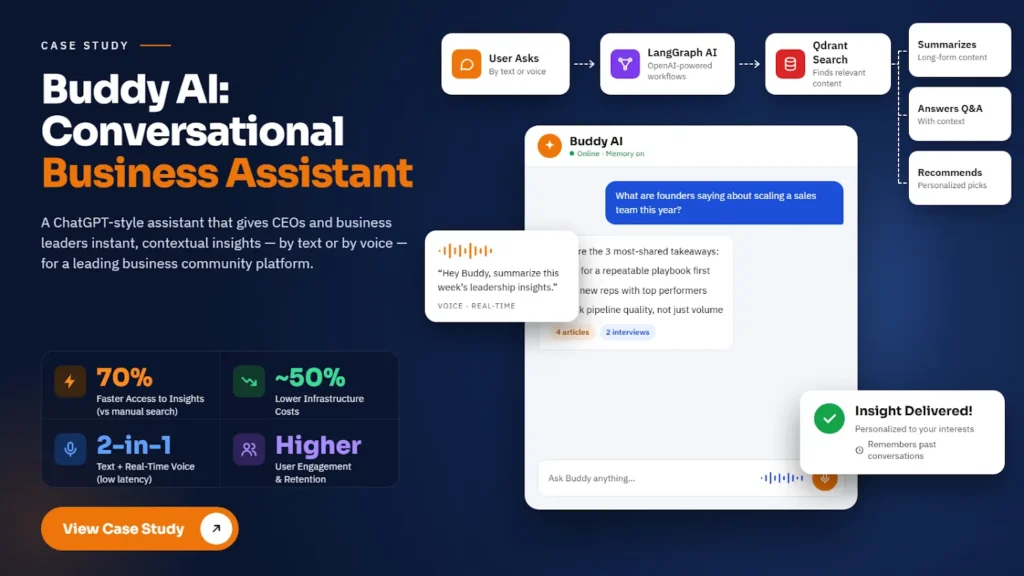
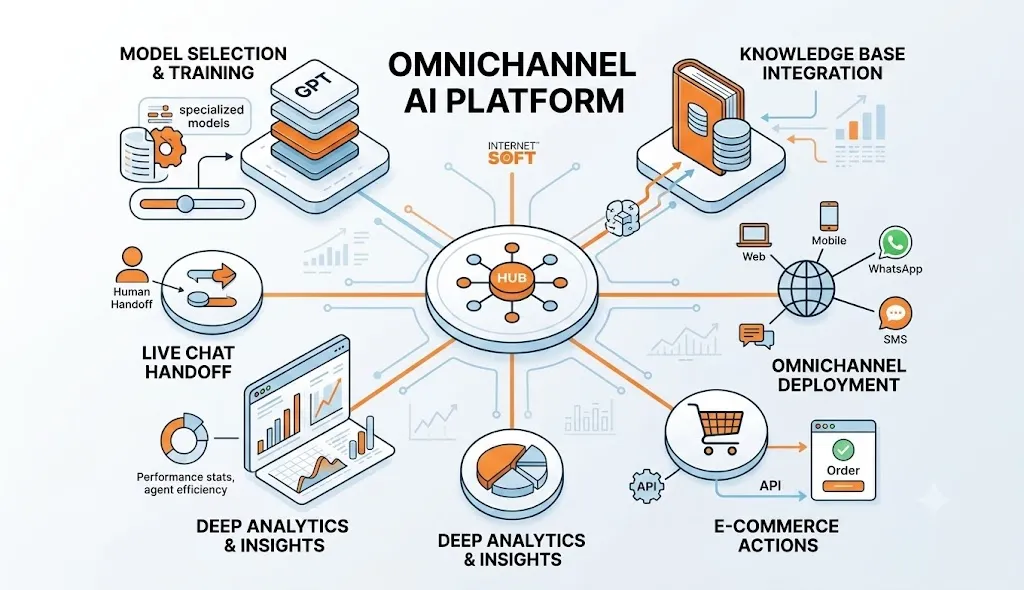
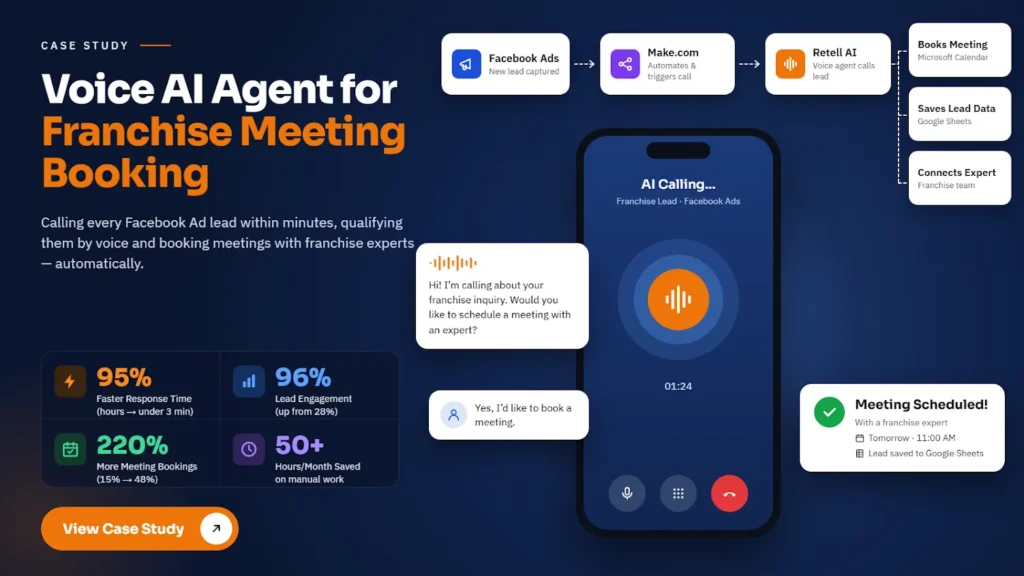
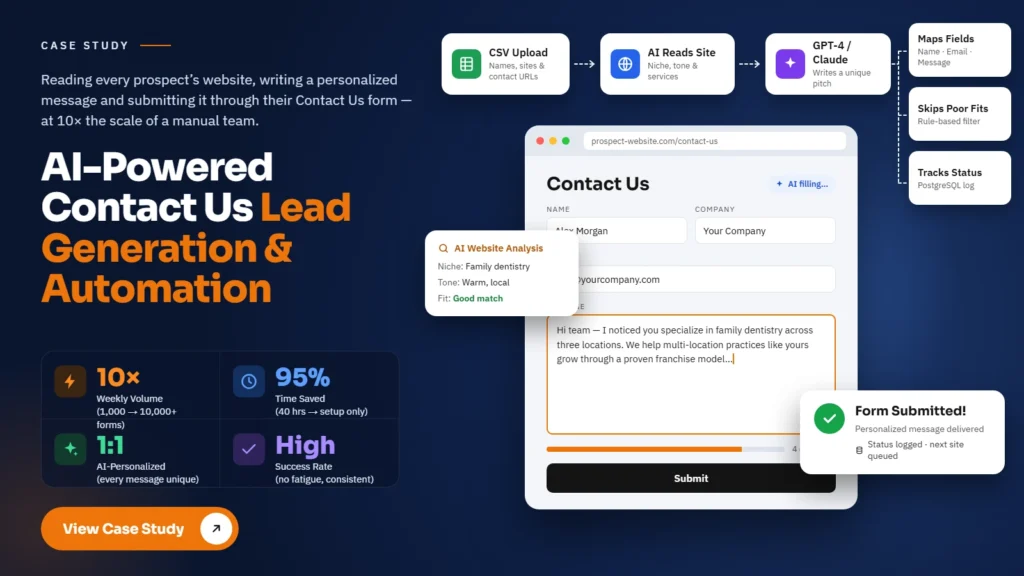
From AI-powered applications to enterprise software, our case studies demonstrate how we create scalable, high-performing solutions that drive business growth and operational efficiency.
Operational Challenges
Implementing autonomous AI requires more than connecting an LLM to a workflow. Businesses need reliable reasoning, controlled tool access, accurate data, security, monitoring, and scalable architecture. Our Agentic AI solutions address these challenges through carefully designed AI architectures and engineering practices.
Automate Complex Multi-Step Workflows
Manual processes involving multiple systems and decisions can slow operations. Agentic AI can coordinate tasks, execute actions, and move workflows forward with minimal intervention.
Reduce Repetitive Decision-Making
Teams often spend significant time reviewing information and making routine decisions. AI agents can analyze context, apply predefined business rules, and recommend or execute appropriate actions.
Connect Disconnected Business Systems
AI agents can interact with APIs, databases, enterprise applications, and business tools to bring fragmented workflows together into a connected automation layer.
Improve Access to Business Knowledge
Employees may spend valuable time searching through documents, databases, and internal systems. Agentic AI can retrieve relevant information and use it as context while completing tasks.
Maintain Control Over Autonomous Actions
Autonomous systems require appropriate safeguards. We design controlled tool access, permissions, validation steps, and human approval mechanisms for sensitive workflows.
Improve Agent Reliability
AI agents can produce inconsistent results if workflows are poorly designed. We implement structured outputs, validation, monitoring, and evaluation processes to improve reliability.
Scale AI Workflows
As workloads grow, AI systems need scalable infrastructure and efficient orchestration. We design architectures that support increasing users, data, agents, and workflow complexity.
Monitor AI Agent Performance
Continuous monitoring helps identify failures, unexpected behavior, latency, and performance issues. We implement observability and evaluation mechanisms to improve agent performance over time.
AI Development Process
We follow a structured approach to design Agentic AI systems around your business objectives, workflows, data, and technology environment.
1
Discovery & Use Case Identification
We understand your business processes, identify suitable agentic use cases, define objectives, and determine where autonomous AI can create measurable value.
2
Workflow & Agent Architecture
We map workflows, define agent responsibilities, identify required tools and integrations, and design the architecture for single-agent or multi-agent systems.
3
Knowledge & Data Integration
We connect agents with relevant business data, documents, APIs, databases, vector stores, and enterprise systems to provide the context required for accurate task execution.
4
Agent Development & Orchestration
We build and orchestrate AI agents using suitable models, frameworks, tools, memory, workflows, and business logic.
5
Testing & Evaluation
We evaluate agent responses, reasoning workflows, tool usage, reliability, security, and edge cases to ensure the system performs consistently.
6
Deployment & Optimization
We deploy the solution into the required environment, monitor performance, optimize workflows, and continuously improve the system based on real-world usage.
WHY CHOOSE INTERNET SOFT?
AI Expertise. Software Engineering. Autonomous Intelligence.
At Internet Soft, we combine AI expertise with proven software engineering capabilities to develop Agentic AI systems that are designed for real-world business environments. From AI strategy and architecture to agent development, integration, deployment, and optimization, we provide end-to-end expertise for building intelligent systems.
A Technology Partner Focused on Your Success
At Internet Soft, we don’t believe in one-size-fits-all technology. We understand your business goals, processes, and challenges before designing the right solution. Our expertise across AI, software engineering, cloud, data, and digital transformation enables us to deliver secure and scalable solutions that evolve with your business.

15+
Years of Software Engineering Experience
100+
Certified Full-Time Professionals
265+
Technology Professionals Across Diverse Skills & Industries
700+
Projects Delivered Worldwide
700+
Projects Delivered Worldwide
AI + Engineering Expertise
Combine advanced AI capabilities with proven software engineering to build production-ready solutions—not just prototypes.
End-to-End Development
From discovery and architecture to development, integration, deployment, monitoring, and optimization, we support the complete AI development lifecycle.
Secure & Controlled Autonomy
We design appropriate permissions, validation mechanisms, human-in-the-loop controls, and secure integrations for responsible agent execution.
Scalable Architecture
Our Agentic AI solutions are designed to support growing workloads, additional agents, new tools, expanding data sources, and evolving business requirements.
TECHNOLOGY STACK
Our Agentic AI technology stack combines AI models, agent frameworks, data platforms, orchestration tools, APIs, and cloud infrastructure to build intelligent and scalable AI systems.
Core AI Frameworks
TensorFlow
PyTorch
Hugging Face
Scikit-learn
AI & NLP Technologies
Natural Language Processing
Embeddings
Semantic Search
Prompt Engineering
Acceleration & Inference
CUDA
cuDNN
ONNX
TensorRT
Foundation Models
OpenAI GPT
Anthropic Claude
Google Gemini
Meta Llama
Mistral AI
Agent Frameworks & Orchestration
LangChain
LlamaIndex
LangGraph
CrewAI
AutoGen
Vector Databases
Pinecone
Qdrant
Weaviate
Chroma
Milvus
Knowledge Technologies
RAG
Embeddings
Semantic Search
Knowledge Graphs
Document Processing
Model Serving
BentoML
Ray Serve
TF Serving
Triton
Agent Tools & Protocols
Function Calling
Tool Use
MCP (Model Context Protocol)
Agent Memory
Multi-Agent Systems
API & System Integration
REST APIs
Webhooks
API Integrations
CRM Integrations
Enterprise Applications
Data Integration & Transformation
DBT
Fivetran
Backend & APIs
Python
FastAPI
Node.js
REST APIs
Data & Storage
PostgreSQL
MongoDB
Redis
Data Processing
Apache Kafka
Apache Spark
dbt
Fivetran
AI Monitoring & Evaluation
LangSmith
MLflow
Weights & Biases
AI Evaluation
Agent Monitoring
Observability
Prometheus
Grafana
Logging & Tracing
Performance Monitoring
Data Processing
Apache Kafka
Apache Spark
dbt
Fivetran
AWS AI
Amazon Bedrock
Amazon SageMaker
AWS Lambda
Google Cloud AI
Vertex AI
Gemini API
Google Cloud
Azure AI
Azure OpenAI
Azure AI Foundry
Azure Machine Learning
Azure AI Services
Frequently Asked Questions
Agentic AI refers to AI systems designed to pursue defined goals by reasoning through tasks, selecting actions, using tools, and completing multi-step workflows with varying levels of autonomy.
An AI agent is typically designed to perform specific tasks or actions, while Agentic AI focuses on systems that can manage more complex objectives by planning, reasoning, using multiple tools, and adapting their actions based on the situation.
Agentic AI can support workflows such as customer service, research, data analysis, document processing, lead qualification, business operations, knowledge management, IT support, and multi-system process automation.
Projects with clean, well-structured data, along with clearly defined goals, move faster. However, more complex use cases, advanced AI models, or heavy third-party integrations may require more time. Thorough testing is also essential to ensure accuracy, reliability, and performance.
A typical timeline includes:
- Problem definition and planning: 2 to 4 weeks
- Data collection and preparation: 4 to 12 weeks
- Model development and training: 8 to 16 weeks
- Testing and evaluation: 4 to 8 weeks
- Deployment and Maintenance: Ongoing
Yes. Agentic AI solutions can integrate with APIs, CRMs, ERPs, databases, cloud services, internal applications, and other enterprise systems to perform actions within existing workflows.
Yes. Agents can be connected to enterprise documents, databases, knowledge bases, and vector databases to retrieve relevant information and use it while performing tasks.
A multi-agent system consists of multiple specialized AI agents that collaborate on a larger objective. Different agents can handle tasks such as research, analysis, planning, execution, or validation.
We design appropriate access controls, tool permissions, validation mechanisms, monitoring, audit logs, data protection, and human approval workflows where required.
Yes. Agentic AI workflows can include human-in-the-loop checkpoints where users review, approve, modify, or reject actions before they are executed.
The timeline depends on the complexity of the workflow, number of agents, integrations, data sources, model requirements, security requirements, and deployment environment. A clearly defined use case and well-structured data can significantly simplify development.
Yes. Agentic AI architectures can be designed to scale across users, workloads, data sources, agents, and business processes while maintaining appropriate monitoring and governance.